
In response to HB4135, a 2026 bill proposing an annual “HPV Awareness Day,” Oregonians for Medical Freedom is offering these resources for more complete “awareness” about HPV and the HPV vaccine.
HPV Educational Resources on this page:
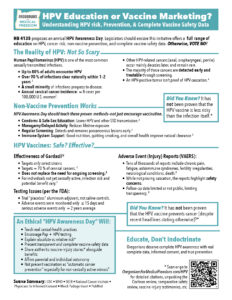
- Download OFMF’s “HPV Education or Vaccine Marketing?” flyer and view references for the flyer.
- It has not been proven that the HPV vaccine prevents cancer (despite recent headlines stating otherwise)
- Pap Screening has Prevented More Cancers Than Vaccines
- HPV: Marker or Cause of Cancers?
- Absolute vs. Relative Risk
- Comparative Review
- Personal Testimonies of Adverse Events
- Alternative and Adjunct Therapies that have been used by some for cancers
📚 References
- Centers for Disease Control and Prevention.
“About HPV — How common is HPV?”
(Accessed 2026). → Up to 80 % infection rate; > 90 % clear spontaneously. - National Cancer Institute (SEER Program).
“Cervical Cancer — Statistics.”
Incidence ≈ 8 cases per 100 000 U.S. women annually. - World Health Organization.
“Sexually Transmitted Infections (STIs): Prevention and Control.”
Safe‑sex education and condom use reduce HPV transmission. - American Cancer Society.
“Cervical Cancer Screening Guidelines.”
Regular Pap and HPV testing prevent > 90 % of deaths. - National Library of Medicine PubMed ID 11740693 (Smith JS et al., J Infect Dis 2002).Nutrition and immune status influence viral clearance.
- Merck & Co.
“Gardasil 9® Prescribing Information (2025 revision).”
Indications limited to types 6, 11, 16, 18, 31, 33, 45, 52, 58 - Physicians for Informed Consent.
“Oppose AB‑659 — HPV Vaccine Position Statement.”
Effectiveness and risk‑benefit context for non‑sexually active individuals. - U.S. Department of Health and Human Services / CDC VAERS Database.
“Vaccine Adverse Event Reporting System (VAERS) Public Data.”
Almost 82,000 post‑HPV‑vaccination reports (worldwide adverse events, including serious outcomes). - National Vaccine Information Center (NVIC).
“HPV Disease and Vaccine Information.”
Details on informed consent and vaccine risk transparency.
* Absolute vs Relative Risk Note: Derived from CDC SEER data and published modeling analyses showing an absolute annual cervical‑cancer risk of ≈ 8 per 100 000 women vs a relative reduction of ≈ 70 % among those already at risk. See NCI SEER Cervical Cancer Stats and CDC MMWR Surveillance Summaries 2021; 70(Suppl 1):1‑53.
Did You Know? It has not been proven that the HPV vaccine prevents cancer (despite recent headlines stating otherwise)?
Watch this short video for an explanation of how the Cochran study does NOT prove that the HPV vaccine prevents cervical cancer:
Pap Screening Has Prevented Far More Cervical Cancers Than Vaccines So Far
Pap (cytology) screening was responsible for the major declines in cervical cancer incidence and mortality long before HPV vaccines were introduced.
That decline began in the 1950s–1990s, decades prior to HPV vaccine licensing in 2006.
1️⃣ Primary Data
- National Cancer Institute (SEER Database)
Between 1955 and 1992, the U.S. cervical‑cancer death rate fell by ≈ 70 %, a reduction contemporaneous with widespread
Pap testing programs
(1). - American Cancer Society
“Regular Pap testing has reduced cervical‑cancer incidence and mortality by > 60 % since the 1950s.”
(2)
2️⃣ Vaccine Introduction Timeline
- HPV vaccine first licensed (Gardasil®) — June 2006 (U.S. FDA).
At that point, cervical‑cancer incidence had already plateaued at a low rate (≈ 8 per 100 000 women per year) due to Pap screening.
(3)
3️⃣ Early Post‑Vaccine Impact Studies
- Population modeling through the 2010s shows that, compared to the 70 % decline achieved by Pap screening, the vaccine’s measurable impact on national cervical‑cancer incidence so far has been modest — single‑digit percentage reductions limited to highly vaccinated birth cohorts
(4).
According to the National Cancer Institute’s SEER Program and the American Cancer Society,
Pap screening has already reduced cervical‑cancer mortality in the United States by more than 60–70 %, far exceeding the impact observed since HPV vaccine introduction in 2006.
🔗 References
National Cancer Institute (SEER Database) – Cervical Cancer Statistics & Trends (SEER Cancer Statistics Review 1975–2018)
. ↩︎
American Cancer Society – Cancer Facts & Figures 2023 (CS333419 2023)
. ↩︎
U.S. Food & Drug Administration – Gardasil® Licensing Announcement (2006)
. ↩︎
CDC MMWR Surveillance Summaries 2021; 70(Suppl 1): 1‑53 – HPV Vaccination Impact Monitoring
. ↩︎
HPV: Cancer Marker or Cause?
⚖️ Why This Matters
Current slogans such as “HPV causes virtually all cervical cancers” simplify a complex biological process and can mislead the public.
Legislators framing “HPV Awareness Day” should understand that the presence of a virus ≠ proof of causation.
1. Association Is Not Causation
- HPV DNA is detected in most cervical tumors, but infection is cleared spontaneously in > 90 % of cases within 1–2 years
1. - Only a small fraction of persistent infections progress to malignancy, showing HPV is not sufficient to cause cancer
2. - Population studies identify 5 – 25 % of cervical cancers that are HPV‑negative even after sensitive testing
34. - Many HPV‑positive tumors have broken or silent viral genes, indicating incidental association
5.
Several sub‑types of cervical cancer—adenocarcinoma, clear‑cell, neuroendocrine—have been documented
without detectable HPV DNA
34.
2. Verified Co‑Factors in Cervical Carcinogenesis
HPV interacts with numerous environmental and physiologic influences. These co‑factors are required for persistent infection and malignant transformation.
| Category | Established Co‑Factors | Mechanisms |
|---|---|---|
| Chronic Inflammation / STIs | Chlamydia trachomatis, Trichomonas, bacterial vaginosis | Sustained tissue injury & oxidative stress 6 |
| Smoking / Toxins | Tobacco, dioxins, endocrine disruptors | DNA adduct formation 7 |
| Nutritional Deficiency | Folate, selenium, vitamins A & E deficiency | Reduced DNA‑repair capacity 8 |
| Hormonal Factors | Long‑term oral contraceptives, DES exposure | Micro‑environmental changes 9 |
| Immune Suppression | HIV infection, steroids, transplant drugs | Inhibits HPV clearance 10 |
| Genetic Susceptibility | p53 & HLA variants | Alters response to oncogenic stimuli 11 |
3. Epidemiologic Context
- Cervical‑cancer rates fell > 70 % from 1955 to 2000—long before HPV vaccines—due to Pap screening programs
12. - Roughly 99 % of HPV infections never become clinically significant, yet this context is often omitted 1.
HPV infection is common → Cancer is rare → Causation is multifactorial.
Comprehensive prevention must address immune health, toxins, nutrition & screening.
📚 References
- CDC – Human Papillomavirus (HPV) and Cancer Statistics (2024). ↩︎
- Walboomers JM et al., J Pathol 1999; 189: 12‑19. ↩︎
- Clifford G et al., Int J Cancer 2006; 119: 891‑899. ↩︎
- Syrjänen K., Apmis 2010; 118: 494‑511. ↩︎
- Koshiol J., Schiffman M., Cancer Epidemiol Biomarkers Prev 2010; 19: 2979‑2986. ↩︎
- Smith JS et al., J Infect Dis 2002; 185: 283‑291. ↩︎
- Prokopczyk B et al., J Natl Cancer Inst 1997; 89: 868‑873. ↩︎
- Butterworth CE et al., Am J Clin Nutr 1992; 55: 992‑996. ↩︎
- Moreno V et al., Lancet 2002; 359: 1085‑1092. ↩︎
- Clifford GM et al., AIDS 2006; 20: 1907‑1915. ↩︎
- Madeleine MM et al., Cancer Epidemiol Biomarkers Prev 2001; 10: 997‑1002. ↩︎
- National Cancer Institute (SEER Program) – Historical Trends in Cervical Cancer (1955–2000). ↩︎
⚖️ Absolute vs Relative Risk — and Why It Matters
Absolute risk means the actual, real‑world chance of something happening. Relative risk is a comparison — it shows the proportional difference between two groups.
Health campaigns often highlight relative risk because it makes benefits (or dangers) sound larger than they are, even when the absolute risk difference is very small.
🧪 Example – HPV and Cervical Cancer
➡ Absolute Risk
- In the U.S., about 8 women per 100 000 develop cervical cancer each year.
- This equals 0.008 % per year, or roughly 1 in 12 000 women.
➡ Relative Risk (How Promotion Often Frames It)
- If vaccination prevents 70 % of cervical cancers among the small number of women who might develop it, the claim becomes “70 % fewer cervical cancers!”
- But the absolute risk reduction is only from 0.008 % to 0.002 % — a difference of about 6 cases per 100 000 women each year.
🩺 Why HPV Awareness Day Should Address Both
When public information uses only relative risk figures (“Prevents 70 % of cervical cancers!”) it can create an exaggerated sense of danger or urgency. Presenting absolute risk adds honesty and context — helping people understand scale and make proportionate decisions.
| Presentation Style | Example Statement | Public Perception |
|---|---|---|
| Relative Risk | “The vaccine prevents 70 % of cervical cancers.” | Sounds dramatically protective; emotional impact is high. |
| Absolute Risk | “It may prevent about 6 cases per 100 000 women each year.” | Accurate scale of benefit; encourages balanced judgment. |
True awareness means seeing the actual odds. HPV Awareness Day should teach both absolute and relative risk so Oregonians can make evidence‑based, proportionate decisions — not fear‑based ones.
🧾 Comparative Review: Gardasil & Gardasil 9 – FDA, EMA, and Independent Safety Evidence
This consolidated summary provides publicly available evidence from U.S. and EU regulatory files, manufacturer data, and large‑scale reviews. It focuses on transparency in safety findings, study design, and post‑marketing outcomes.
🧪 1. FDA Biologics License Application (BLA) Review Files
FDA – Gardasil BLA # 125126 / 125508 (Biologics License Applications)
Synopsis: These are the original FDA documentation files for Gardasil (Quadrivalent) and Gardasil 9. They include pre‑licensure safety summaries, trial enrollment by age & sex, adverse‑event tables, use of aluminum‑containing controls, and post‑approval surveillance requirements.
FDA Quote:
“Vaccination with GARDASIL 9 does not eliminate the necessity for recipients to undergo regular cervical screening. GARDASIL 9 protects only against those cancers caused by HPV 16, 18, 31, 33, 45, 52, & 58.” (FDA)
Context Highlights:
- Trial “placebos” contained AAHS (aluminum adjuvant) rather than saline controls.
- Most solicited adverse events were monitored ≤ 15 days after each injection.
- Follow‑up for serious adverse events was short (1–4 years, median ≈ 2 years).
📄 2. Merck Product Inserts and Clinical Study Data
Gardasil 9 Prescribing Information (2025 revision)
Gardasil (Quadrivalent) Prescribing Information (2025)
Key Details from FDA‑approved label:
- Contains ≈ 500 µg aluminum (AAHS) per 0.5 mL dose.
- Common adverse events: injection‑site pain, swelling, erythema, headache (10–90 %).
- Serious adverse events reported in ≈ 2.3 % of Gardasil 9 recipients (354 of 15,705) vs 2.5 % for Gardasil control (185 of 7,378).* 1
| Study Group | Pain (any) | Swelling (any) | Erythema (any) | Headache (any) | Serious AEs |
|---|---|---|---|---|---|
| Girls/Women 16–26 yr (Gardasil 9) | 89.9 % | 40.0 % | 34.0 % | 14.6 % | 2.3 % (354/15,705) |
| Boys/Men 16–26 yr (Gardasil 9) | 63.4 % | 20.2 % | 20.7 % | 7.3 % | 2.3 % |
| Girls 9–15 yr (Gardasil 9) | 89.3 % | 47.8 % | 34.1 % | 11.4 % | 2.3 % |
| Women 27–45 yr (Gardasil 9) | 82.8 % | 23.3 % | 16.9 % | 13.6 % | 2.3 % |
*Serious adverse event = any life‑threatening event, hospitalization, disability, or death reported during follow‑up period. Sources: FDA BLA; Merck PI Sections 6 & 14.
“Four GARDASIL 9 recipients each reported at least one serious adverse event deemed vaccine‑related: pyrexia, allergy to vaccine, asthmatic crisis, and headache.” – FDA/Merck Clinical Trials Summary
📑 3. European Medicines Agency (EMA) Assessment Reports
EMA – European Public Assessment Report for Gardasil 9
Synopsis: EMA’s review covers five main clinical studies with > 14,000 participants (16–26 yrs) and immune‑bridging studies in children 9–15 yrs.
Vaccine efficacy and safety were compared with the earlier quadrivalent Gardasil product.
EMA Quote:
“Gardasil 9 can provide protection against all nine types of HPV infection… In five main studies involving > 25,000 subjects, the vaccine stimulated adequate antibody levels in both sexes.” – EMA EPAR Summary
EMA Safety Tables (Reported Solicited Adverse Reactions in EU Pivotal Trial Population):
| Reaction Type | Gardasil 9 (% of Recipients) | Comparator Gardasil (% of Recipients) | Duration of Observation |
|---|---|---|---|
| Injection‑site pain (any) | ≈ 90 % | ≈ 83 % | ≤ 5 days post dose |
| Swelling (any) | ≈ 48 % | ≈ 36 % | ≤ 5 days post dose |
| Erythema (any) | ≈ 34 % | ≈ 29 % | ≤ 5 days post dose |
| Headache | ≈ 11 – 15 % | ≈ 11 – 14 % | ≤ 15 days post dose |
| Pyrexia (≥ 100 °F) | ≈ 6 % | ≈ 6 % | ≤ 5 days post dose |
EMA notes that rare autoimmune syndromes (POTS, CRPS) were reported post‑marketing, but “causality could not be determined.” – EPAR Post‑Authorization Summary.
⚖️ 4. Independent and Governmental Reviews
- National Academies (IOM) – Adverse Effects of Vaccines (2011): Declared evidence “insufficient to accept or reject” most serious HPV vaccine outcomes; noted that trials did not use true placebos.
- Cochrane HPV Vaccine Review (2018 / 2020 update): Concluded vaccine is “generally safe,” but reviewed data lacked power for rare events and relied on industry datasets with selective reporting bias.
🌍 5. Post‑Marketing Systems and Litigation
- Vaccine Safety Datalink (VSD): Tracks conditions such as syncope, POTS, autoimmune events using EHR data (~15 million persons).
- U.S. Vaccine Injury Compensation Program (VICP): Dozens of HPV vaccine‑related petitions for neurological and autoimmune injuries; aggregate tallies published online.
- Federal Gardasil MDL No. 3036 (Litigation): Consolidates hundreds of claims; Merck must produce internal safety records for public court review.
🔬 6. Integrated Safety Evidence Matrix (FDA vs EMA vs Merck)
| Parameter | FDA (BLA Files & Prescribing Info) | EMA (EPAR Reports) | Manufacturer (Merck Clinical Data) |
|---|---|---|---|
| Total Subjects in Pivotal Trials | ≈ 29,000 (Gardasil); ≈ 15,700 (Gardasil 9) | ≈ 25,000 across EU trials | ≈ 30,000 combined global participants |
| Control Composition | AAHS (aluminum adjuvant) | AAHS (adjuvanted control) | AAHS control — no true saline placebo |
| Injection‑site Pain (any) | 63 – 90 % | ≈ 90 % | ≈ 89 % |
| Severe Pain (disabling) | ≈ 0.6 – 4 % | — | ≈ 4 % |
| Swelling (any) | 20 – 48 % | ≈ 48 % | ≈ 40 % |
| Systemic Fever (≥ 100 °F) | 4 – 6 % | ≈ 6 % | ≈ 6 % |
| Headache Systemic Reaction | 11 – 15 % | ≈ 13 % | 14 % |
| Serious Adverse Events (All Causes) | 2.3 % | Similar range (not specified) | 2.3 % vs 2.5 % controls (FDA table) |
| Trial Follow‑Up for AEs | up to 48 months (~4 yrs) | 3.5 yrs median | same as FDA data |
| Autoimmune Syndrome Reports (POTS/CRPS) | Post‑marketing case reports | “Causality not established” | Monitored in post‑authorization studies |
Sources: FDA Clinical Review Tables; Merck PI § 6, §14; EMA EPAR Summary Tables (2018‑2025); CDC VSD public descriptions.
Footnotes
- FDA/Merck Safety Comparison – “Serious adverse events reported in 354 of 15,705 (2.3 %) Gardasil 9 recipients and 185 of 7,378 (2.5 %) controls.” (Source)
Adverse Events Stories:
https://www.gardasilhpvtruths.com
Search for “videos” and “HPV” to find several testimonies here:
https://childrenshealthdefense.org/search/
https://www.nvic.org/disease-vaccine/hpv
Scroll down for stories in the left side menu
Integrative and Adjunctive Therapies for HPV‑Related Cancers
This document distinguishes between alternative supportive or adjunctive treatments—those that work alongside or enhance conventional therapy—and “alternative cures,” which typically lack rigorous outcome data and may be hazardous if used to replace standard care completely.1
There are legitimate, evidence‑backed or emerging non‑mainstream approaches that have shown benefit, particularly when used under proper medical supervision, for HPV‑related cancers such as cervical, oropharyngeal, and anal cancers.2
🌿 1️⃣ Integrative / Holistic Medical Therapies (Adjunctive to Standard Care)
- High‑Dose Vitamin C (IV Ascorbate)
Mechanism: Pro‑oxidant at high plasma levels.
Evidence: Phase I/II trials show improved quality of life, reduced chemo side effects.3 - Hyperthermia Therapy
Mechanism: Localized or whole‑body heating improves oxygenation and sensitivity to treatment.4 - Photodynamic Therapy (PDT)
Mechanism: Light‑activated tumor destruction via photosensitizing agents.5 - Ozone and Oxidative Therapies
Mechanism: Improves oxygen delivery and immune responsiveness.6 - Autologous NK‑Cell and Dendritic Cell Immunotherapy
Mechanism: Personalized immune stimulation against HPV antigens.7
🧬 2️⃣ Metabolic and Nutritional Approaches
- Ketogenic or Low‑Glucose Protocols — suppress glycolysis and reduce inflammatory signaling.8
- Curcumin (Turmeric Extract) — blocks NF‑κB and AP‑1 involved in HPV oncoprotein activity.9
- Green Tea Polyphenols (EGCG) — inhibit viral gene expression and activate apoptosis.10
- Medicinal Mushrooms (Reishi, Coriolus, Maitake) — stimulate innate immunity and NK‑cell function.11
- Botanical Antivirals — Astragalus, Andrographis, Scutellaria improve interferon activity.12
⚗️ 3️⃣ Emerging or Investigational Adjuncts
| Experimental Therapy | Mechanism | HPV‑Related Rationale | Status |
|---|---|---|---|
| Repurposed Drugs (Metformin, Mebendazole, LDN) | Metabolic modulation | Chemo‑sensitivity | Phase II/III |
| DMSO + Natural Agents | Improves tissue oxygenation | Surface lesions | Experimental |
| PolyMVA (ALA Complex) | Mitochondrial support | Redox repair | Pilot U.S. studies |
| Pulsed Electromagnetic Field (PEMF) | Membrane repolarization | Inflammatory precancers | Palliative EU use |
🩺 4️⃣ Public and Policy Perspective
Cancer awareness must consider that progress expands beyond patents or vaccines; HPV‑driven cancers are multicausal — involving immunity, metabolism, and environmental health.13
📋 Responsible Guidelines
- Consult integrative oncologists and licensed practitioners.14
- Ensure IV and oxidative methods follow sterile, regulated protocols.
- Combine — not replace — surgery, radiation, or chemo when curative intent exists.
✅ Summary – Top Supported Adjuncts
- High‑Dose IV Vitamin C
- Hyperthermia
- Photodynamic Therapy
- Curcumin & EGCG
- Medicinal Mushrooms
- NK/Dendritic Immunotherapy
- Ketogenic / Metabolic Support
- Ozone‑Oxygen Therapy
- Mind‑Body Detoxification
Always confer with a qualified healthcare professional before starting any therapy.
📚 References & External Links
- National Cancer Institute – Complementary & Integrative Health Overview ↩
- NCI: HPV and Cancer ↩
- NIH Trials of Intravenous Vitamin C in Cancer ↩
- Hyperthermic Oncology in Cervical Cancer – Systematic Review ↩
- Photodynamic Therapy of HPV‑Associated Lesions ↩
- Ozone Therapy in Oncology – Mechanisms and Outcomes ↩
- Dendritic Cell/NK‑Cell Therapy in HPV‑Positive Tumors ↩
- Ketogenic Diets in Cancer Metabolism ↩
- Curcumin and HPV Oncoprotein Suppression Studies ↩
- EGCG Antiviral and Antitumor Effects ↩
- β‑Glucan Immunomodulators in Oncology ↩
- Astragalus and Andrographis for Viral Immunity ↩
- Holistic Approach to HPV‑Related Cancer Outcomes ↩
- Society for Integrative Oncology – Clinical Guidelines ↩
Educational Books:
Knockout: Interviews with Doctors Who Are Curing Cancer–And How to Prevent Getting It in the First Place
https://www.amazon.com/
Chris Beat Cancer: A Comprehensive Plan for Healing Naturally
https://www.amazon.com/Chris-
The Metabolic Approach to Cancer: Integrating Deep Nutrition, the Ketogenic Diet, and Nontoxic Bio-Individualized Therapies
https://www.amazon.com/
The Maverick M.D. – Dr. Nicholas Gonzalez and His Fight for a New Cancer Treatment
https://www.amazon.com/